The Modern Mothers of Gynecology—Honoring Black Women Exploited in the Name of Progress

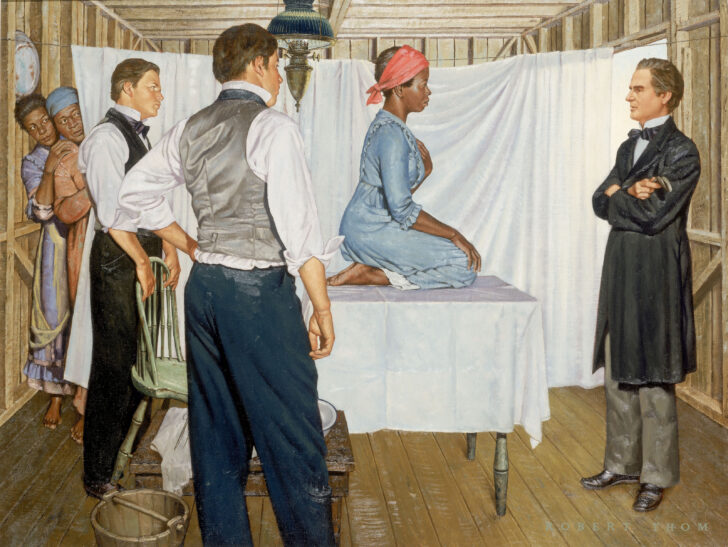
— THE SHORT VERSIONModern gynecology was built in part through the exploitation of enslaved Black women, whose contributions have often been erased from history.
Anarcha, Lucy, and Betsey endured repeated experimental surgeries without consent or anesthesia, helping shape procedures that are still used today.
Their story highlights how racism, power, and medicine have historically intersected—and whose pain was deemed worthy of care.
The legacy of this history persists. Black women continue to face disparities in pain treatment, maternal health outcomes, and healthcare experiences.
Honoring Anarcha, Lucy, and Betsey means telling the full story of medical history and working toward a healthcare system rooted in dignity, equity, and respect.
Reframing the Story We’ve Been Told
For generations, medical textbooks and history lessons have credited J. Marion Sims as the “father of gynecology.” His name is attached to instruments, procedures, and professional accolades that helped shape modern reproductive medicine. What is often left out of this story is how that knowledge was obtained—and who paid the price.
This is not a story about innovation in isolation. It is a story about Black enslaved women whose bodies were used, without consent or care, to advance a medical field that continues to serve millions today. This Black History Month, we pause to reclaim the story—and to honor the women history tried to erase.
Medicine, Enslavement, and Power
In the mid-19th century, American medicine operated within a system that legally defined enslaved people as property, not patients. Enslaved Black women had no bodily autonomy and no legal right to refuse medical treatment or experimentation.
At the same time, racist medical myths flourished. Physicians widely believed that Black women experienced less pain, had stronger bodies, or were biologically suited for physical suffering. It is these horrifying belief systems that allowed Sims to perform cruel, inhumane, and torturous experiments on innocent Black women.
Within this context, medical “advancement” came at the expense of the most vulnerable. The power imbalance between white physicians and enslaved Black women made abuse not only possible, but normalized.
The Women Behind the Experiments: Anarcha, Lucy, and Betsey
In the 1840s, J. Marion Sims “leased” enslaved women in Alabama who had developed a painful medical condition following childbirth. These women were taken from slaveholders who viewed their injuries not as something to be healed, but as an inconvenience—because the women could no longer perform forced labor.
Striving to become the first physician to repair vesico-vaginal fistulas (abnormal openings between the bladder and the vagina), Sims repeatedly performed experimental surgeries on numerous enslaved Black women; we know the names of three: Anarcha, Lucy, and Betsey.
For five years, these women were treated as test subjects. Sims operated on the same women again and again, without anesthesia, believing the procedures were “not painful enough to justify the trouble.” This belief persisted despite the visible suffering he documented himself. In his autobiography, Sims wrote, “Lucy’s agony was extreme. She was much prostrated, and I thought that she was going to die…” Her pain was clinically observed, and then ignored.
Anarcha endured at least 30 experimental surgeries for obstetric fistulas. Her suffering was prolonged and central to the eventual development of the surgical technique, yet her own healing and humanity were never the priority.
The women continuously developed post-operative infections, lived in agony for days, and were then operated on again—and again.
This history should be hard to read. It is hard to sit with. But it demands our attention.
A Prioritization of Dignity and Respect
These experiments represent the monstrosity of power abuse and racism in healthcare, and the prioritization of whose pain is believed, treated, and cared for—and whose right to privacy and care is granted.
Lucy was the first of the three to undergo the experimental operation. She was brought into the operating room naked, restrained on the table, and observed by multiple other doctors, all without her consent.
Only after these techniques were perfected on Black women—without anesthesia—did Sims perform the surgery on white women under entirely different conditions. White patients received anesthesia and were afforded a level of dignity and privacy that Anarcha, Lucy, and Betsey were never given.
Naming These Women Matters
Naming Anarcha, Lucy, and Betsey is not just an act of correction—it is a refusal to continue centering the so-called “father of gynecology” while erasing the women who made the field possible. Their suffering, though never chosen, shaped the foundations of modern gynecology.
Honoring them shifts recognition away from a singular hero narrative and toward the truth: that gynecology was built through the bodies, pain, and resilience of Black women. Behind every medical advancement are real people whose lives shaped it, often without consent and care.
Anarcha, Lucy, and Betsey are not footnotes in medical history.
The Legacy That Sadly Lives On
Black women continue to face unjust outcomes in our healthcare system. These disparities are rooted in a long history of medical exploitation, dismissal, and harm.
Black women’s pain is less likely to be believed. Among Black women who have been pregnant or given birth, nearly 1 in 5 say they were refused pain medication they believed they needed—reflecting racial bias in how pain is assessed and treated.
Racial bias in healthcare persists. Black women report feeling unheard, dismissed, or disrespected at higher rates than any other racial group.
Black women are 3x more likely to die from pregnancy-related causes than white women.
These outcomes reflect deep-rooted bias and structural inequality in how Black women’s bodies, pain, and care needs are understood.
A Commitment to Remember
In recent years, there has been a growing recognition that honoring J. Marion Sims without reckoning with the harm he inflicted is incompatible with ethical medicine. In 2018, his statue was removed from New York City’s Central Park—a symbolic step away from celebrating a legacy built on the suffering of Black women.
But removing a statue is not the same as restoring dignity.
That work begins with naming Anarcha, Lucy, and Betsey—and refusing to let them remain erased from the history they shaped. It requires acknowledging that modern gynecology was not born solely from innovation, but from exploitation. And it asks us to carry this truth forward as we imagine what equitable, ethical care can look like today.
This Black History Month, we honor the women whose bodies were used without consent, whose pain was ignored, and whose humanity was denied. Remembering them is not about looking backward — it is about building a future of care rooted in dignity, accountability, and respect.
Sources:
NPR: Remembering Anarcha, Lucy, and Betsey: The Mothers of Modern Gynecology
NPR: 'Father Of Gynecology,' Who Experimented On Slaves, No Longer On Pedestal In NYC
Women & The American Story:Life Story: Anarcha, Betsy, and Lucy
Black Perspectives:Black Subjectivity and the Origins of American Gynecology
KFF: Five Facts About Black Women’s Experiences in Health Care
The Harvard Gazette: How Lucy, Betsey, and Anarcha became foremothers of gynecology
Written By: